

A Follicle Intelligence.ai company
Understand your hair today. Protect it for the future.
Specialist hair and scalp assessment, clinical treatment planning and long-term monitoring—combining human expertise with the Follicle Intelligence.ai ecosystem.
Specialist-led assessment · Personalised clinical interpretation · Evidence-informed planning · Long-term monitoring
Specialist Hair and Scalp Intelligence
A clearer clinical picture of your hair health
Hair Longevity Institute brings together specialist assessment, scalp and follicular analysis, clinical history, structured imaging, personalised treatment planning and longitudinal monitoring—so decisions are grounded in a fuller picture, not a single glance.
The HLI pathway
Assess → Understand → Plan → Monitor
One continuous patient journey—from first review to long-term follow-up.
- 01
Assess
Review the patient’s history, concerns, scalp, hair pattern and available clinical evidence.
- 02
Understand
Interpret likely causes, patterns, contributing factors and areas requiring further investigation.
- 03
Plan
Develop an appropriate treatment, monitoring or referral pathway based on the individual clinical picture.
- 04
Monitor
Track change, treatment response and hair health over time through structured review and follow-up.
Clinical scope
More than a single hair-loss diagnosis
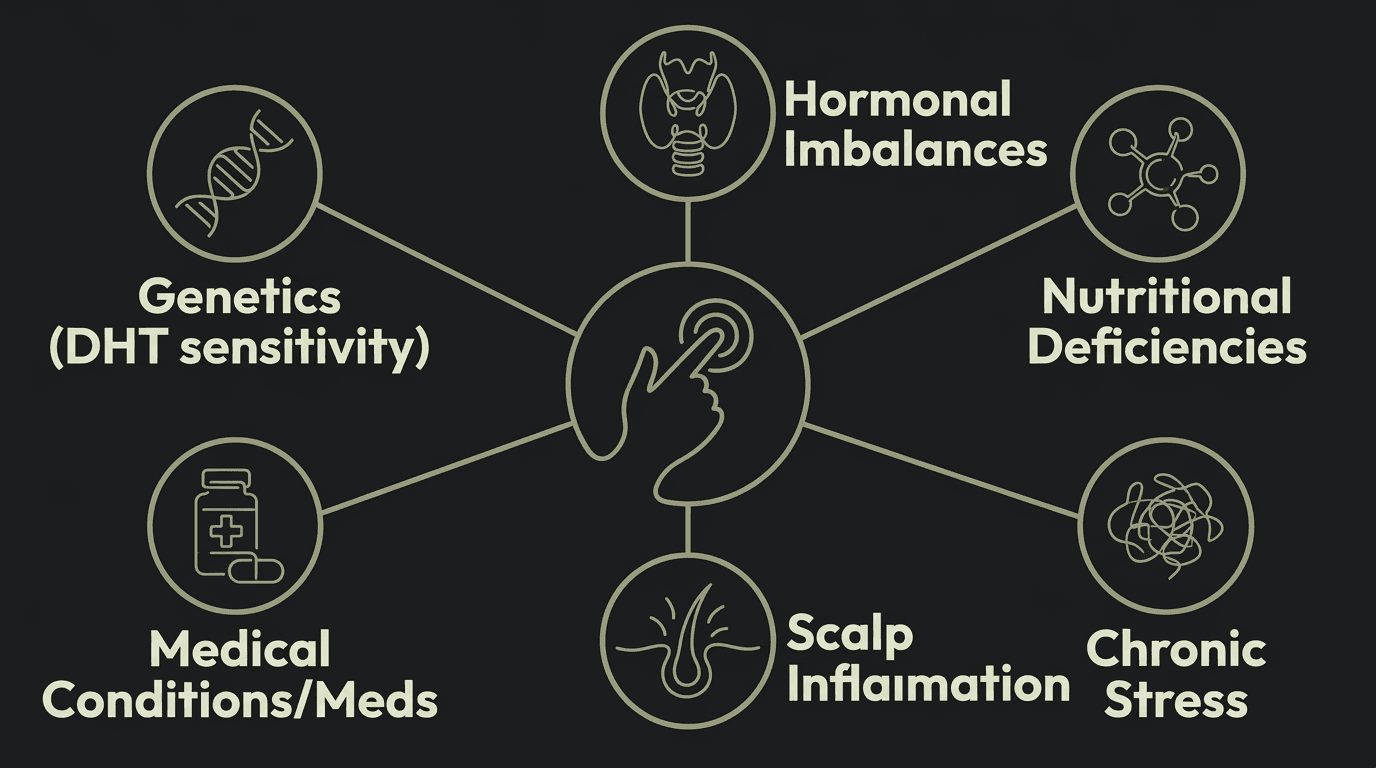
An HLI assessment looks across the factors that may contribute to how hair and scalp health appear and change—without implying that every finding confirms a definitive diagnosis on its own.
Findings are interpreted in clinical context. Some presentations need further investigation; others need monitoring before intervention.
- Pattern and progression of hair loss
- Scalp and follicular health
- Hair density and miniaturisation
- Shedding and diffuse thinning
- Treatment history and response
- Medical or hormonal contributing factors
- Hair-restoration suitability
- Long-term preservation planning
Illustrative clinical imaging support — not a patient result or diagnostic claim.
Clinical Imaging
See what cannot be understood from appearance alone
Trichoscopy and structured clinical imaging may help clinicians observe features that are difficult to assess from appearance alone—supporting a more careful interpretation of the scalp and hair.
Imaging may contribute information about density, shaft variation, miniaturisation, scalp changes, follicular patterns, and treatment response over time. It does not independently diagnose every form of hair loss; findings are read alongside history and clinical judgement.
Treatment planning
A plan shaped around the evidence
HLI’s role is not simply to sell a treatment. Recommendations depend on the assessment findings, clinical history and individual circumstances.
Clinical treatment options
Scalp-health management
Medical review
Pathology or further investigation
Regenerative treatment discussion
Hair-restoration suitability
Monitoring before intervention
Referral to another professional
An HLI plan may include clinical options, monitoring, further investigation or referral—only where appropriate for the individual clinical picture.
Hair Longevity
Monitor change, not just a single appointment
HLI is designed to support patients over time by comparing symptoms, clinical images, treatment use, scalp condition, hair pattern, response and progression.
The goal is not simply to record where your hair is today, but to build a clearer picture of how it changes.
Monitoring informs review and planning. It does not promise that every form of future hair change can be prevented.
Connected Clinical Intelligence
Specialist judgement, supported by a more connected system
HLI combines specialist clinical interpretation with structured tools from the Follicle Intelligence.ai ecosystem—helping organise evidence, support continuity and build a more complete longitudinal picture.
Clinician first
Technology supports the clinician. It does not replace professional judgement.
Clinical context
Patient information is interpreted within clinical context—not in isolation.
Continuity
Connected systems help improve continuity of review across the care journey.
Hair Longevity Institute is part of the Follicle Intelligence.ai group.
Detailed product pathways live in the site footer. This page stays focused on the patient and the institute.
Research & clinical development
Contributing to a better understanding of hair loss and ageing
HLI engages with clinical observation, structured imaging and longitudinal monitoring to deepen how hair and scalp change are understood—while remaining careful about what the evidence can and cannot support.
- Trichoscopy and structured imaging
- Hair ageing and follicular longevity
- Androgenetic and female pattern hair loss
- Scalp health and inflammatory contributors
- Treatment-response monitoring
- Longitudinal clinical evidence
Professional pathway
For clinicians and hair-health professionals
Access specialist resources, clinical collaboration, structured assessment pathways and research-informed education.
Begin With Understanding
Start with a clearer picture of your hair health
Begin your Hair Longevity Institute assessment and take the first step toward a more informed treatment and monitoring plan.
Common questions
Questions before you start
Is the initial analysis really free?
Yes. You can start your initial hair analysis at no cost.
Do I need blood tests before I begin?
No. You can begin with symptoms, history, and any information you already have. Blood tests can be added later.
Do I need scalp photos to start?
No. Photos are helpful, but they are not required to begin.
Do I need a referral?
No referral is required.
When do I pay?
Only if you choose optional services: a blood request letter, a follow-up blood analysis review, membership, or the separate one-hour trichologist appointment. Your first clinical review pathway begins free.
What does membership include?
Membership is $10 per month and includes blood request letters, blood analysis reviews, ongoing support while your membership is active, and two 30-minute one-on-one Zoom consultations per calendar year — not per month, and not a lifetime allowance.
What is the difference between membership Zoom sessions and the paid appointment?
Membership includes two 30-minute one-on-one Zoom sessions per calendar year at no extra charge while you are subscribed. The optional trichologist appointment is different: a dedicated 1-hour session for $120 USD when you want extended time beyond those included visits.
Do I need to book an appointment to get started?
No. You can start with the free initial analysis first.
Can HLI prescribe medication?
HLI helps guide investigation, interpretation, and next steps, but prescriptions must be handled through the appropriate doctor or prescriber.